- Japanese
- English
Regional CEO Asia/Pacific
The climate crisis is one of the most urgent challenges worldwide. The clarity and urgency of the climate crisis stem from a confluence of clear evidence, observable changes in the environment, and the direct impacts on human and ecological systems around us today. The cumulative effects of these factors underscore the need for sustained action from individuals, governments, and organizations worldwide.
Schaeffler is a leading motion technology company with footprint across 200 locations in more than 50 countries and as a global organization, we take this as one of our core responsibilities. Schaeffler Group wants to be part of the solution and the company has already embarked on a clear climate action plan.
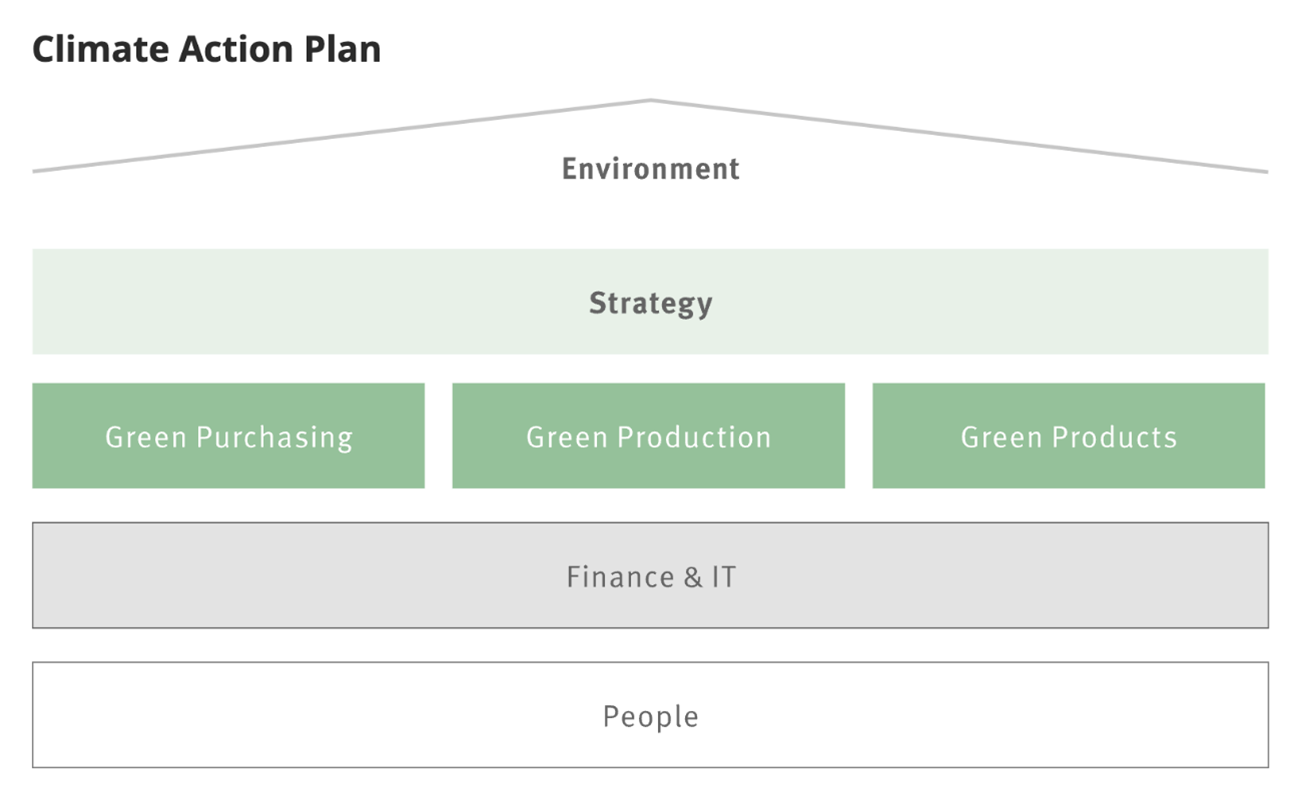
In executing our Climate Action Plan, the company is guided by six elements:
- 1. Strategy: Strategic anchoring of decarbonization in key business processes.
- 2. Green Purchasing: Development and sourcing of low-emission materials and services.
- 3. Green Production: Decarbonization of the factory floor.
- 4. Green Products: Development of new product systems, automated and holistic calculation of carbon footprints.
- 5. Finance & IT: Provision of transparency and appropriate IT infrastructure.
- 6. People: Training and awareness building campaigns for the workforce.
Schaeffler always pursues the premise of being the preferred technology partner of its customers by offering innovation, agility and efficiency. As societies move toward more sustainability, products that are climate-friendly and produced in climate-friendly manner are increasingly essential. Schaeffler is already offering product solutions for a more sustainable future, for example low friction bearings and linear guides, electric drives, hydrogen technologies or renewable energies.
The company, however, is focused not only on its customers but also on internal improvements. The Climate Action Plan provides for climate-neutral production (Scope 1 and Scope 2) by 2030, followed by a climate-neutral supply chain (Scope 3 upstream) by 2040. This plan is consistently being pursued and executed.
Schaeffler has already made some notable progress in that regard, for instance, in own operations (Scope 1 and Scope 2). Those are direct emissions from sources the company controls itself, such as gas and heating oil, and indirect emissions from the generation of purchased energy, such as electric power and district heat. Here, the Schaeffler Group reduced its greenhouse gas emissions between 2019 and 2023 from 986,000 metric tons to 375,000 metric tons of CO2e, by switching from natural gas to electric power in annealing oven operations and the consistent switch to purchased energy from renewable sources.
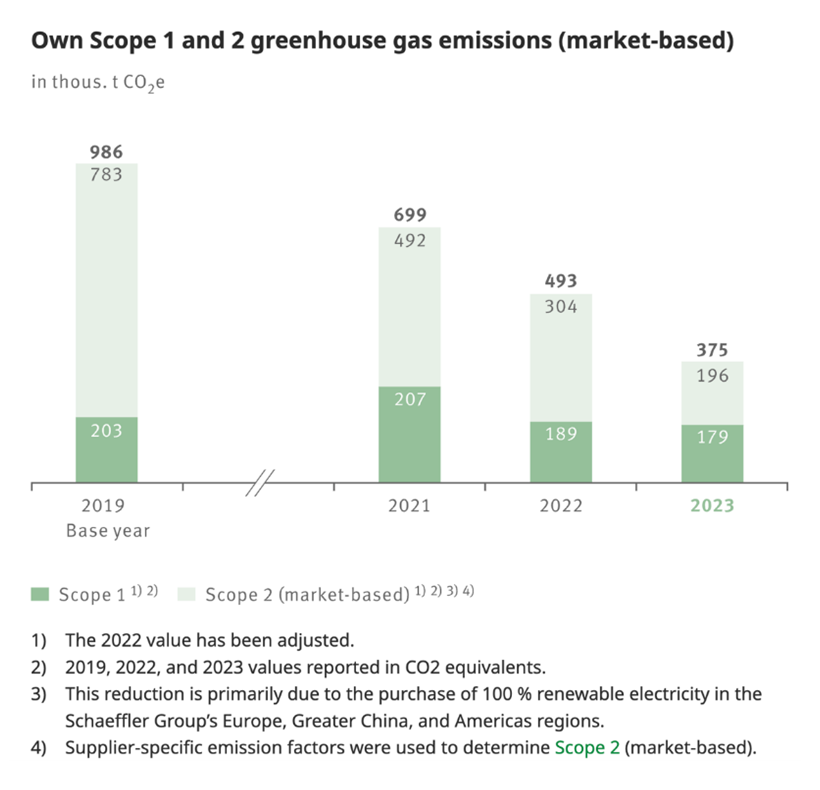
These successes are continuing to provide encouragement for achieving the next goals, which include all purchased upstream products and services such as logistics, energy production, and waste disposal.
Another part of the reductions concerns the use phase of products and their subsequent disposal, the so-called Scope 3 downstream emissions. Relevant working groups have been established for capturing and calculating those emissions and for developing the requisite actions.
In addition to focused approach in reducing emissions, Schaeffler also balances its emission reduction actions by developing a robust ESG (Environment Social and Governance) framework. The framework positively looks at impact to environment, society and governance from all aspects of business. Be it promoting wellbeing of employees, empowering communities, establishing a code of conduct for our partners and vendors to transparency in business reporting and many other facets that enable delivering value for our shareholders.
After all, ambitious long-term sustainability goals can only be achieved with strong programs and collective efforts from all stakeholders. Together, we must continue to raise awareness of sustainable business practices and continually develop and improve the sustainability expertise of our stakeholders. There are still many challenges to overcome. At a macro level, nations like Japan and Germany with their highly industrialized economies will continue to play a pivotal role in steering sustainable technologies to positively contribute towards decarbonization efforts. Schaeffler is well positioned in these markets to partner these efforts enabling clean motion and mobility, to protect our natural resources and maintain quality of life and prosperity.
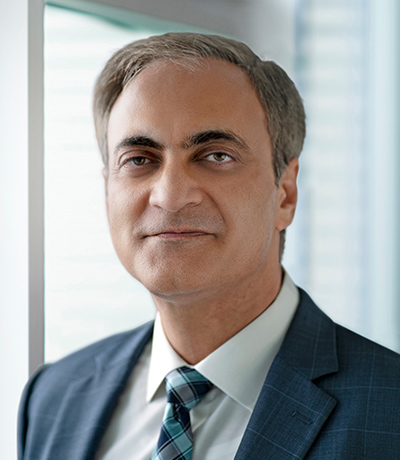
Regional CEO Asia/Pacific
Schaeffler (Singapore) Pte. Ltd
Dharmesh Arora (b: 1967) is a Mechanical Engineer from University of Mumbai and holds the TRIUM Global Executive MBA degree from Stern School of Business, NYU; London School of Economics and HEC Paris.
He began his career as a product engineer with Maruti Suzuki and after a successful stint, he joined General Motors where he worked in the areas of product engineering, supply chain and purchase. Dharmesh Arora held key senior management and global leadership positions at General Motors in India, Thailand, Mexico and USA in a career spanning over two decades.
In 2012, Dharmesh Arora joined Schaeffler as the CEO India and President Automotive business. Under his leadership, Schaeffler India has consolidated its position as a leading supplier of high-quality components and systems for industrial and automotive applications through three product brands FAG, INA and LuK. He successfully led the merger of 3 Indian entities to form one strong Schaeffler entity in India.
Since October 2019 he has been Regional CEO Asia/Pacific for the Schaeffler Group and is based in Singapore.